
The M4 Showdown: MacBook Pro M4 vs. MacBook Air M4 – Which Apple Laptop Reigns Supreme?
The release of a new generation of Apple Silicon is always a landmark event in the tech world, sparking fervent discussions and igniting the age-old debate: which MacBook is right for me? With the anticipated arrival of the M4 chip, the dilemma between the raw power of the MacBook Pro and the elegant portability of the MacBook Air becomes even more nuanced. Both machines, powered by Apple’s cutting-edge silicon, promise unprecedented performance, efficiency, and integration within the Apple ecosystem. However, they are designed for fundamentally different users and workflows.
This comprehensive comparison review delves deep into the expected capabilities of the MacBook Pro M4 and the MacBook Air M4, dissecting their design philosophies, performance metrics, display technologies, thermal management, battery life, and overall value proposition. Our aim is to equip you with all the information needed to make an informed decision, ensuring your next Apple laptop perfectly aligns with your professional and personal demands.
The M4 Chip: A Glimpse into the Future of Apple Silicon
Before we pit the two titans against each other, let’s establish a foundational understanding of the M4 chip itself. Building upon the already impressive M3 architecture, the M4 is expected to push the boundaries further, likely focusing on enhanced AI capabilities, improved energy efficiency, and a significant leap in raw processing power.
Anticipated advancements in the M4 chip include:
- Next-Generation CPU Cores: Expect faster performance cores and even more efficient efficiency cores, leading to a substantial boost in multi-core performance for demanding applications and snappier everyday responsiveness.
- Enhanced GPU Architecture: Apple’s integrated GPUs have been steadily closing the gap with discrete graphics cards. The M4 is likely to introduce further refinements in graphics processing, potentially offering improved ray tracing capabilities, mesh shading, and overall higher frame rates for gaming and graphically intensive tasks.
- Massively Upgraded Neural Engine: With the burgeoning importance of on-device AI and machine learning, the M4’s Neural Engine is poised for a significant upgrade. This will accelerate tasks like image processing, video analysis, voice recognition, and facilitate more complex AI models directly on the device, enhancing privacy and speed.
- Improved Memory Bandwidth and Latency: Faster access to unified memory is crucial for demanding workflows. The M4 is expected to optimize memory architecture, allowing the CPU and GPU to share data more efficiently.
- Potentially a More Advanced Manufacturing Process: Moving to a more refined process (e.g., a further optimized 3nm node) would contribute to higher transistor density, better performance per watt, and reduced heat generation.
These improvements mean that both the M4 MacBook Pro and M4 MacBook Air will be incredibly capable machines. The key differentiation, however, lies in how each model leverages and sustains that power.
Design & Portability: Elegance vs. Endurance
The most immediate and obvious distinction between the MacBook Air and MacBook Pro lies in their physical design and the philosophy behind it.
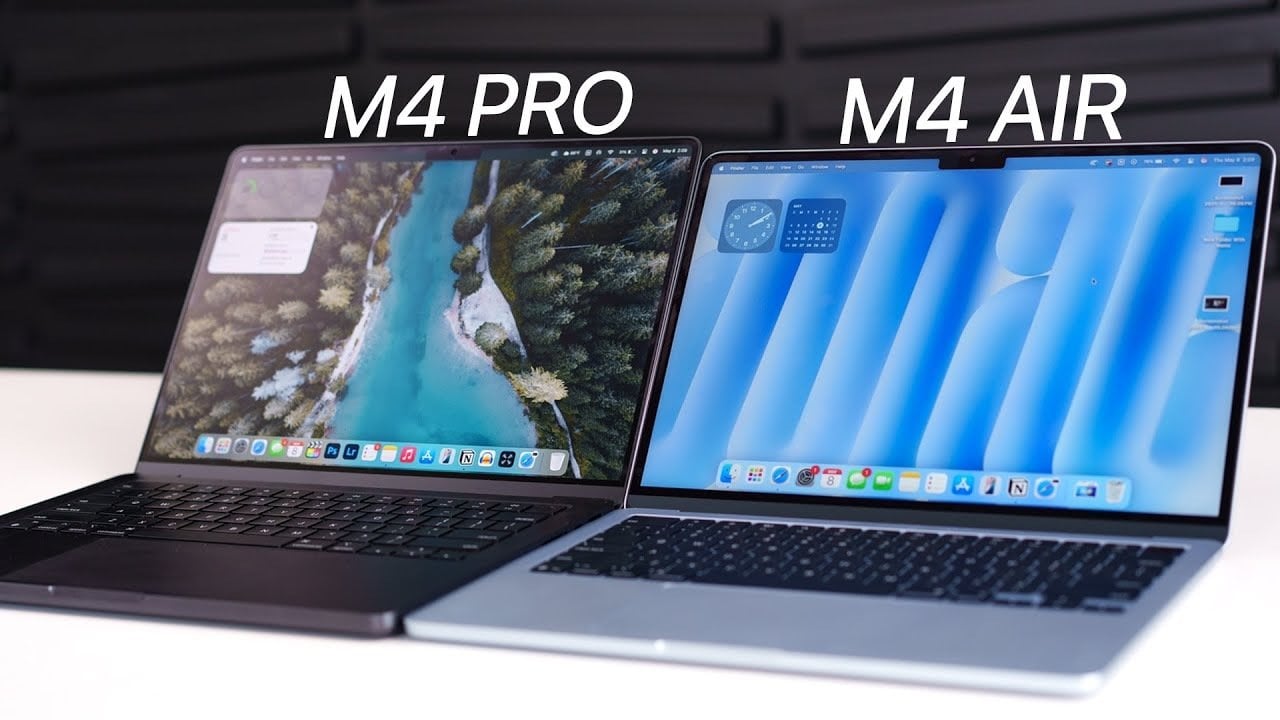
MacBook Air M4: The Air epitomizes portability and minimalist design. It’s designed to be effortlessly carried anywhere, a seamless extension of your digital life without adding significant weight or bulk. Expect the M4 Air to retain its signature thin and light profile, likely maintaining the uniform, flat-edged design introduced in recent generations, moving away from the classic wedge shape. Its construction will continue to feature a robust, recycled aluminum unibody, offering a premium feel without the heft. The fanless design is a hallmark of the Air, ensuring silent operation, which is a significant advantage in quiet environments like libraries, lecture halls, or professional meetings. This quietude, however, comes with a trade-off, which we’ll explore in the performance section. For users constantly on the move, students, or those who value an "invisible" computing experience, the Air’s design is unparalleled.
MacBook Pro M4: The MacBook Pro, while still remarkably portable for its power, adopts a more substantial and robust design. It’s built for endurance and the demands of professional workflows. The M4 Pro will likely maintain its slightly thicker and heavier chassis compared to the Air, a necessity to accommodate its advanced thermal management system and more extensive port selection. The Pro’s design language emphasizes strength and functionality, often available in more subdued color options like Space Gray and Silver, reflecting its professional target audience. While not as featherlight as the Air, the Pro’s weight is a small price to pay for the enhanced performance and features it brings to the table. Its build quality instills confidence, designed to withstand the rigors of frequent travel and demanding use.
Verdict on Design: If ultimate portability, silence, and a sleek, unobtrusive form factor are your top priorities, the MacBook Air M4 is the clear winner. If you need a more robust machine that prioritizes sustained performance and a wider array of connectivity options, and you don’t mind a slight increase in weight and thickness, the MacBook Pro M4 is the better fit.
Display Technology: Visual Brilliance for Every Eye
Apple has consistently set high standards for its laptop displays, and the M4 generation will be no exception. However, there’s a significant divergence in display technology between the Air and Pro models.
MacBook Air M4: The M4 MacBook Air will undoubtedly feature a stunning Liquid Retina display. These panels offer excellent color accuracy (P3 wide color gamut), high resolution, and impressive brightness, making them perfect for general productivity, web browsing, casual content consumption, and even light photo and video editing. The colors are vibrant, text is crisp, and the overall visual experience is highly enjoyable for the vast majority of users. While it might not reach the extreme brightness levels of the Pro, it’s more than adequate for indoor and typical outdoor use.
MacBook Pro M4: This is where the Pro truly shines, especially for creative professionals. The MacBook Pro M4 will feature Apple’s groundbreaking Liquid Retina XDR display, powered by mini-LED technology. This display offers:
- Extreme Dynamic Range (XDR): Unparalleled contrast ratios with incredibly deep blacks and brilliant highlights, making HDR content (movies, professional video edits) look absolutely stunning and true to life.
- Exceptional Brightness: Capable of sustained full-screen brightness for HDR content (e.g., 1000 nits) and peak brightness (e.g., 1600 nits), making it usable even in very bright environments and essential for HDR grading.
- ProMotion Technology: Adaptive refresh rates up to 120Hz provide incredibly smooth scrolling, fluid animations, and a more responsive feel. This is particularly beneficial for video editors working with high frame rate footage, gamers, and anyone who appreciates a buttery-smooth visual experience.
- Superior Color Accuracy: While the Air is excellent, the Pro’s XDR display offers even greater precision for color-critical work in photography, graphic design, and video production.
The display on the MacBook Pro is not merely an upgrade; it’s a professional tool. The notch, which houses the webcam and ambient light sensors, remains a characteristic feature of the Pro models, allowing for thinner bezels.
Verdict on Display: For most users, the MacBook Air M4’s Liquid Retina display is more than sufficient and visually pleasing. However, for content creators, videographers, photographers, graphic designers, or anyone who demands the absolute best in visual fidelity, extreme brightness, and smooth motion, the MacBook Pro M4’s Liquid Retina XDR with ProMotion is a non-negotiable feature and a significant differentiator.
Performance: Raw Power vs. Everyday Efficiency
Both M4 machines will be remarkably fast, but their performance profiles are distinctly different, primarily due to thermal management.
MacBook Air M4: The M4 MacBook Air will be an absolute powerhouse for everyday computing. Tasks like web browsing with dozens of tabs, complex spreadsheets, presentations, light photo editing, casual video editing (up to 4K), coding, and general productivity will be handled with effortless grace. Thanks to the M4 chip’s efficiency, even without a fan, the Air can deliver impressive burst performance. For short, intensive tasks, it will feel just as fast as the Pro. However, its fanless design means that under prolonged, heavy loads (e.g., rendering a long 4K video, compiling massive codebases, intensive 3D modeling), the chip will eventually begin to "throttle" its performance to prevent overheating. This isn’t a flaw; it’s a deliberate design choice that prioritizes silence and portability. For the vast majority of users who don’t push their machines to their absolute limits for extended periods, the M4 Air’s performance will be more than adequate.
MacBook Pro M4: This is where the MacBook Pro truly earns its "Pro" moniker. Equipped with an active cooling system (fans), the M4 MacBook Pro is designed to sustain peak performance for extended periods without throttling. This means that the full, unbridled power of the M4 chip – potentially with more CPU and GPU cores in higher-tier configurations – can be unleashed and maintained for hours on end.
- Demanding Creative Work: For professional video editors working with 8K footage, complex VFX, intensive 3D rendering, high-resolution photo manipulation with many layers, or professional audio production with countless tracks and plugins, the Pro’s sustained performance is critical.
- Software Development: Compiling large projects in Xcode or other IDEs, running multiple virtual machines, and managing complex development environments will benefit immensely from the Pro’s thermal headroom.
- Scientific Computing & Data Analysis: Tasks involving large datasets, simulations, and machine learning model training will execute significantly faster and more reliably on the Pro.
- Serious Gaming: While not primarily a gaming machine, the M4 Pro, especially higher-tier configurations, will offer the best gaming experience on a MacBook, thanks to its powerful GPU and sustained performance.
The MacBook Pro M4 will also likely offer more configurable options for unified memory (RAM) – potentially up to 128GB or even more – and higher capacity SSDs, catering to the storage and memory demands of professional workflows.
Verdict on Performance: For general productivity, light creative tasks, and silent operation, the MacBook Air M4 offers phenomenal performance. However, if your workflow involves sustained, processor-intensive tasks, professional creative applications, or large-scale development, the MacBook Pro M4’s active cooling and higher-tier chip options are indispensable, allowing you to harness the M4’s full potential without compromise.
Thermal Management & Sustained Performance: The Core Difference
This section is essentially an expansion of the performance discussion, but it’s so critical that it warrants its own focus. The difference in thermal management is the fundamental engineering decision that defines the performance ceiling for each machine.
MacBook Air M4 (Fanless): The Air relies on passive cooling, meaning heat is dissipated through the aluminum chassis. This design choice results in a completely silent machine, a huge benefit for many users. However, physics dictates that without active airflow, there’s a limit to how much heat a chip can generate before it reaches unsafe temperatures. To prevent this, the M4 chip in the Air will employ thermal throttling. When the CPU or GPU temperatures rise above a certain threshold during prolonged heavy use, the chip will automatically reduce its clock speed and power consumption. This keeps the laptop cool and quiet but means that intensive tasks will take longer to complete than on a fanned system, or they might experience slowdowns during execution. For bursty workloads (e.g., opening a large file, quick photo edits), the Air will feel incredibly fast, as it can ramp up to peak performance for short periods.
MacBook Pro M4 (Active Cooling): The MacBook Pro’s slightly thicker chassis houses an advanced active cooling system, typically involving one or more fans and sophisticated heat pipes. This system actively draws heat away from the M4 chip, expelling it from the chassis. This allows the M4 chip in the Pro to run at its peak clock speeds for much longer durations, potentially indefinitely, without throttling. For professionals, this is paramount. Imagine rendering a 10-minute 4K video: on the Air, it might start fast but slow down halfway through as throttling kicks in; on the Pro, it will maintain its maximum rendering speed from start to finish. This directly translates to significant time savings and a more predictable workflow for intensive tasks.
Verdict on Thermal Management: If silent operation is your absolute priority and your workloads are generally light to moderate, the MacBook Air M4’s fanless design is a marvel. If your work involves consistent, heavy CPU/GPU loads where sustained peak performance is non-negotiable, the active cooling system of the MacBook Pro M4 is essential for maximizing productivity and leveraging the M4 chip’s full potential.
Battery Life: All-Day Powerhouses
Apple Silicon has redefined laptop battery life, and the M4 generation will continue this tradition. Both the Air and Pro models are expected to deliver exceptional endurance.
MacBook Air M4: The M4 MacBook Air, thanks to its highly efficient M4 chip and potentially lower power draw from its display (compared to the Pro’s XDR), will likely offer slightly longer battery life in light to moderate usage scenarios. Apple’s stated battery life figures are often conservative, and the Air typically lives up to or exceeds them, providing genuinely all-day power. Users can expect to comfortably get through a full workday, a long flight, or multiple study sessions without needing to reach for a charger. Its efficiency makes it an ideal companion for travel and remote work.
MacBook Pro M4: While the Pro has a more powerful chip and a more demanding display (Liquid Retina XDR with ProMotion), it also typically houses a larger battery capacity. As a result, its battery life is still outstanding, easily capable of lasting a full workday. However, when pushed hard with demanding tasks like 4K video editing or 3D rendering, its power consumption will naturally increase, leading to a shorter runtime compared to light usage. Despite this, the Pro remains one of the longest-lasting high-performance laptops on the market.
Verdict on Battery Life: Both M4 MacBooks offer phenomenal battery life, far exceeding most competitors. The Air might have a slight edge in pure endurance during light use due to its display and fanless design, but the Pro still delivers an impressive all-day experience, even with its more powerful components. You’ll rarely be left scrambling for a charger with either machine.
Ports & Connectivity: Expanding Your Workspace
Connectivity is another crucial area where the Pro differentiates itself from the Air, catering to the needs of professionals.
MacBook Air M4: The M4 MacBook Air typically comes equipped with a streamlined port selection, usually consisting of two Thunderbolt / USB 4 ports and a MagSafe charging port. While perfectly adequate for most users who rely on wireless peripherals or use a single external display, it necessitates the use of adapters or docks for connecting multiple accessories, external storage, or different display types (e.g., HDMI). The simplicity keeps the design sleek but can be a point of friction for some.
MacBook Pro M4: The MacBook Pro M4 offers a significantly more robust and versatile array of ports, designed to meet the demands of professional workflows. Expect:
- Multiple Thunderbolt / USB 4 Ports: Often three or four, allowing for multiple high-speed peripherals, external GPUs (though less necessary with powerful Apple Silicon), and daisy-chaining displays.
- HDMI Port: Crucial for directly connecting to projectors, external monitors, and TVs without needing an adapter.
- SDXC Card Slot: A godsend for photographers and videographers who frequently offload footage from cameras.
- MagSafe Charging Port: Present on both, offering convenient and safe magnetic charging.
- Advanced Wireless: Both models will support the latest Wi-Fi standards (e.g., Wi-Fi 7) and Bluetooth (e.g., Bluetooth 5.4) for cutting-edge wireless connectivity.
The Pro’s comprehensive port selection minimizes the need for dongles, streamlining professional workflows and expanding the machine’s utility as a workstation.
Verdict on Ports: For users with minimal connectivity needs, the MacBook Air M4’s port selection is sufficient. However, for professionals who regularly connect to multiple external displays, camera cards, external drives, and other peripherals, the MacBook Pro M4’s generous and varied port selection is a major advantage and a significant time-saver.
Keyboard, Trackpad, & Audio-Visual Experience: Apple’s Signature Polish
Apple’s attention to detail extends to the input devices and multimedia experience, where both machines offer premium experiences, though the Pro typically refines them further.
Keyboard & Trackpad: Both the M4 MacBook Air and MacBook Pro will feature Apple’s acclaimed Magic Keyboard, known for its comfortable key travel, stable keys, and reliable performance. The Force Touch trackpad on both models remains the industry gold standard, offering precise cursor control, multi-touch gestures, and haptic feedback. There’s virtually no discernible difference in the core typing and trackpad experience between the two models – both are excellent.
Webcam: The M4 generation is expected to standardize 1080p FaceTime HD cameras across both lines, offering sharp, clear video quality for video calls, online meetings, and content creation. Apple’s image signal processor (ISP) within the M4 chip will further enhance image quality, improving noise reduction and dynamic range.
Audio: This is an area where the Pro typically pulls ahead.
- MacBook Air M4: Will feature an excellent stereo speaker system, often supporting Spatial Audio with Dolby Atmos. For a thin and light laptop, the sound quality is impressive, with surprising bass and clear highs.
- MacBook Pro M4: Boasts a more advanced high-fidelity, six-speaker sound system with force-cancelling woofers. This delivers richer bass, a wider soundstage, and a more immersive audio experience, crucial for professional audio monitoring or enjoying high-quality media. It also often includes a "studio-quality" three-mic array with high signal-to-noise ratio and directional beamforming for crystal-clear voice capture.
Verdict on Audio-Visual: Both models offer a superb user experience in terms of keyboard, trackpad, and webcam. For general media consumption and communication, the Air is fantastic. However, for critical audio work, a truly immersive listening experience, or professional-grade voice capture, the MacBook Pro M4’s enhanced speaker system and microphone array offer a tangible upgrade.
Price & Value Proposition: Investing in Your Workflow
The final, and often most decisive, factor in the Air vs. Pro debate is the price.
MacBook Air M4: The MacBook Air M4 will undoubtedly be the more affordable entry point into the M4 ecosystem. Its value proposition is incredibly strong: offering phenomenal performance for everyday tasks, unparalleled portability, and silent operation at a significantly lower cost than the Pro. For students, casual users, small business owners, or anyone who doesn’t require the specialized features of the Pro, the Air represents exceptional value for money. It’s an investment in a highly capable, durable, and long-lasting machine that will comfortably handle most computing needs for years to come.
MacBook Pro M4: The MacBook Pro M4 comes with a higher price tag, especially when configured with higher-tier M4 chips (e.g., M4 Pro, M4 Max), more unified memory, and larger SSDs. However, for the professional user, this higher cost is an investment that pays dividends through increased productivity, faster workflow completion, and access to critical features like the XDR display, sustained performance, and extensive port selection. The value here isn’t just in raw power, but in the ability to do more, faster, and with greater precision, ultimately saving time and potentially generating more income for creative professionals and developers. For someone whose livelihood depends on their laptop’s performance, the Pro’s premium price is often justified.
Verdict on Price & Value: If budget is a primary concern and your needs align with general computing and light creative tasks, the MacBook Air M4 offers incredible value. If your work demands the absolute best in performance, display technology, and connectivity, and your livelihood depends on your laptop’s capabilities, the MacBook Pro M4’s higher price tag is a worthwhile investment.
Who Is It For? Pinpointing Your Ideal MacBook M4
Let’s distill the comparison into clear recommendations based on typical user profiles:
Choose the MacBook Air M4 if you are:
- A Student: Perfect for notes, research, essays, presentations, and light creative projects.
- A Casual User: For web browsing, email, streaming, social media, and everyday tasks.
- A Traveler/Commuter: Its lightweight and thin design makes it incredibly easy to carry.
- An Office Worker: Ideal for productivity suites, video conferencing, and general business tasks.
- Someone Prioritizing Silence: Its fanless design ensures a completely quiet operation.
- Budget-Conscious: Offers incredible performance and features at a more accessible price point.
- Light Content Creator: For casual photo editing, basic video editing (up to 4K), and graphic design that doesn’t require sustained heavy loads.
Choose the MacBook Pro M4 if you are:
- A Professional Video Editor: Working with 4K/8K footage, complex color grading, and VFX.
- A 3D Artist/Animator: Requiring sustained rendering power for complex scenes.
- A Software Developer/Engineer: Compiling large codebases, running virtual machines, or heavy data processing.
- A Professional Photographer: Demanding precise color accuracy, extreme brightness, and direct SD card slot access.
- A Music Producer/Audio Engineer: Requiring powerful processing for multiple tracks, plugins, and high-fidelity audio output/input.
- A Power User: Who consistently pushes their machine to its limits with demanding applications.
- Someone Who Needs Extensive Connectivity: Multiple Thunderbolt ports, HDMI, and an SD card reader are essential for your workflow.
- A Serious Gamer: While not its primary purpose, the Pro offers the best gaming experience on a MacBook.
Conclusion: The M4 Era of Choice
The M4 generation of MacBooks reiterates Apple’s masterful segmentation of its laptop lineup. Both the MacBook Pro M4 and MacBook Air M4 are extraordinary machines, powered by a chip that will set new benchmarks for performance and efficiency. There isn’t a single "better" laptop; there is only the laptop that is better for you.
The MacBook Air M4 stands as the undisputed champion of everyday computing. It’s the silent, sleek, and supremely portable workhorse that effortlessly handles the vast majority of tasks with grace and speed. It offers an incredible blend of performance, battery life, and design at a price point that delivers outstanding value. For the casual user, student, or professional who doesn’t engage in prolonged, intensive workloads, the Air is the logical and highly satisfying choice.
The MacBook Pro M4, on the other hand, is a no-compromise professional powerhouse. It’s engineered to unlock the M4 chip’s full, sustained potential, supported by an advanced thermal system, a breathtaking Liquid Retina XDR display, and a comprehensive suite of ports. It’s a tool meticulously crafted for creators, developers, and power users who demand the absolute best in performance, precision, and efficiency to fuel their most ambitious projects. The higher investment is justified by the tangible gains in productivity and the ability to handle workflows that would bring lesser machines to their knees.
Ultimately, your decision hinges on your specific needs, your budget, and how you intend to use your machine. Take stock of your daily tasks, your professional requirements, and your priorities regarding portability versus raw, sustained power. Whichever M4 MacBook you choose, you’ll be investing in a state-of-the-art device that promises to deliver an exceptional computing experience for years to come. The M4 era is here, and with it, the most compelling choice between Apple’s iconic laptops yet.