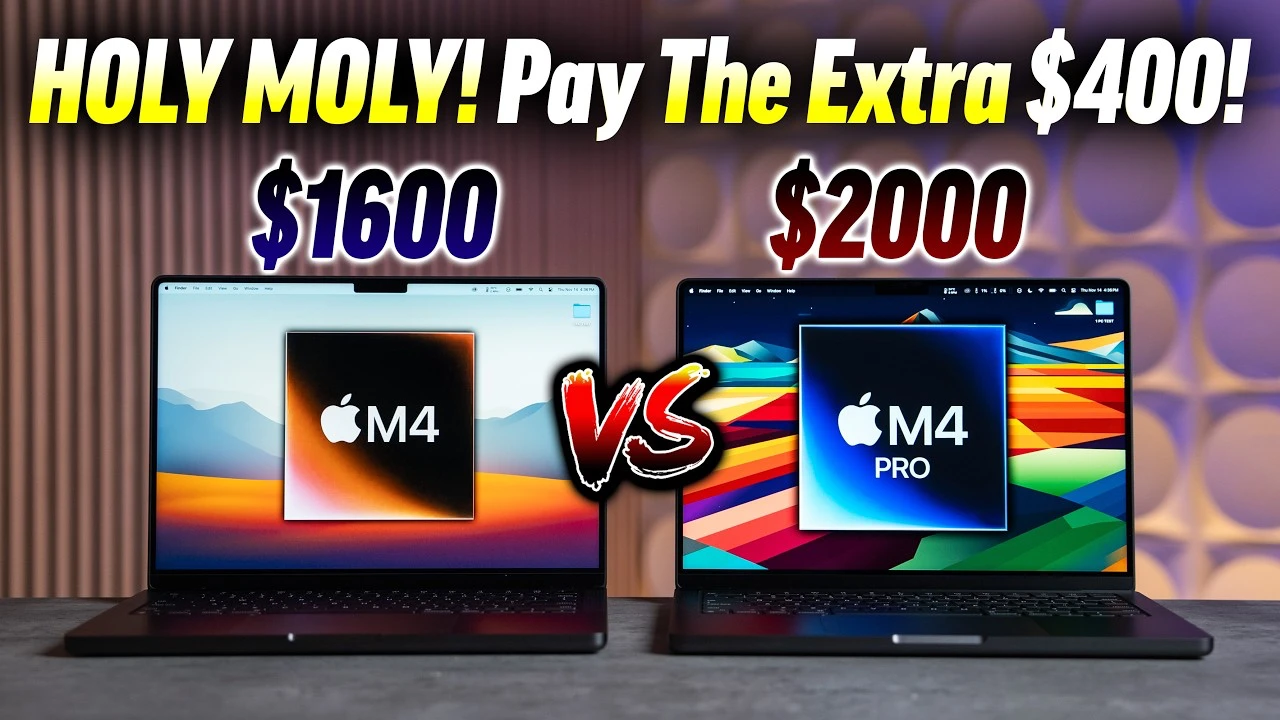

MacBook Pro M4 vs. High-End Windows Laptops for Video Editing: A Comprehensive Showdown
The landscape of video editing is constantly evolving, driven by an insatiable demand for higher resolutions, more complex effects, and faster workflows. At the heart of this evolution lies the choice of hardware, a decision that can profoundly impact a professional editor’s productivity, creativity, and bottom line. For years, the debate has raged between Apple’s meticulously engineered MacBooks and the diverse, powerful ecosystem of Windows laptops. With the anticipated arrival of the MacBook Pro M4, this discussion gains a new layer of complexity, pitting Apple’s refined, integrated silicon against the raw, configurable might of high-end Windows machines.
This article aims to provide an exhaustive comparison, delving into every critical aspect a video editor considers when making such a pivotal investment. We will explore performance benchmarks, architectural philosophies, software ecosystems, display technologies, portability, and value propositions, ultimately helping you determine which platform is the superior choice for your specific video editing needs.
The Contenders: A Closer Look
Before diving into the intricate details, let’s establish the characteristics of our two formidable contenders.
The MacBook Pro M4 (Hypothetical, Building on M-Series Legacy):
Apple’s Silicon revolution, initiated with the M1 chip, has fundamentally reshaped expectations for laptop performance and efficiency. The hypothetical M4, building upon the impressive foundations of the M1, M2, and M3 series, is expected to further refine this architecture. Key tenets include:
- Unified Memory Architecture (UMA): A groundbreaking design where CPU, GPU, and Neural Engine share a single pool of high-bandwidth, low-latency memory. This eliminates the need for data copying between discrete components, significantly accelerating tasks, especially in memory-intensive applications like video editing.
- Integrated Graphics: Unlike traditional systems with separate CPU and GPU, Apple Silicon integrates a powerful GPU directly onto the same die, leveraging UMA for unparalleled efficiency and speed in graphics-intensive tasks.
- Specialized Media Engines: Dedicated hardware accelerators for popular video codecs like ProRes, H.264, and HEVC, ensuring blazing-fast encoding and decoding.
- Neural Engine: Designed for machine learning tasks, which are increasingly relevant for AI-powered features in editing software (e.g., smart reframing, noise reduction, object tracking).
- Power Efficiency: A hallmark of Apple Silicon, allowing for exceptional performance without excessive heat generation or draining battery life.
- macOS Integration: The hardware and software are designed in tandem, leading to unparalleled optimization and a seamless user experience.
The M4 is expected to push these boundaries further with more CPU and GPU cores, increased clock speeds, enhanced Neural Engine capabilities, and potentially new architectural innovations that bolster its leadership in specific areas of creative computing.
High-End Windows Laptops for Video Editing:
The Windows ecosystem, by contrast, is defined by its vast diversity and configurability. These laptops often feature a combination of:
- Intel Core Ultra / i9 or AMD Ryzen 9 Processors: Cutting-edge multi-core CPUs from Intel and AMD, offering high clock speeds, substantial core counts, and advanced instruction sets, often excelling in raw computational throughput.
- Dedicated NVIDIA GeForce RTX or AMD Radeon GPUs: Discrete graphics cards with massive amounts of dedicated VRAM (Video RAM), powerful shader units, and specialized cores (Tensor Cores for AI, RT Cores for Ray Tracing) that provide immense parallel processing power for complex visual effects, rendering, and GPU-accelerated tasks.
- Traditional Memory Architecture: Separate RAM for the CPU and VRAM for the GPU, which can be configured to much higher capacities (e.g., 64GB, 128GB system RAM, 16GB, 24GB VRAM).
- Open Ecosystem: A wide array of manufacturers (Dell, HP, Lenovo, ASUS, MSI, Razer, etc.) offering diverse designs, feature sets, and price points.
- Windows OS: A highly flexible operating system with broad software compatibility and extensive customization options.
These machines are often built to push the boundaries of raw power, offering configurations that can be tailored to specific, demanding workflows, especially those heavily reliant on GPU acceleration or requiring vast amounts of memory.
Core Performance for Video Editing
The heart of any video editing workstation lies in its ability to process, manipulate, and render footage efficiently. This section dissects the performance aspects of both platforms.
Processor (CPU) Performance
MacBook Pro M4:
The M4’s CPU is expected to continue Apple’s tradition of delivering exceptional single-core and multi-core performance, particularly within its power envelope. For video editing, the M4’s advantages stem from:
- ProRes Acceleration: Apple’s dedicated media engines are unparalleled in their ability to encode and decode ProRes footage. For editors working extensively with ProRes (a common intermediate codec in professional workflows), the M4 will offer real-time playback, lightning-fast exports, and smooth manipulation of even 8K ProRes RAW footage, often outperforming machines with significantly more raw CPU/GPU power. This hardware-level acceleration is a game-changer for specific professional pipelines.
- Unified Memory Bandwidth: The sheer bandwidth of the unified memory means the CPU can access data much faster, reducing bottlenecks when handling large video files, complex timelines, and numerous effects. This translates to smoother scrubbing, quicker effect application, and more responsive overall editing.
- Efficiency Cores: The balanced architecture of performance and efficiency cores ensures that lighter tasks consume minimal power, contributing to excellent battery life, while heavier workloads are handled by the powerful performance cores.
- Optimized Software: macOS and Apple’s own Final Cut Pro X are meticulously optimized to leverage every facet of the M-series chips, leading to superior performance in native applications. Even third-party applications like Adobe Premiere Pro and DaVinci Resolve are increasingly optimized for Apple Silicon, though the level of optimization can vary.
High-End Windows Laptops:
Windows laptops, equipped with Intel Core Ultra/i9 or AMD Ryzen 9 processors, offer formidable CPU power.
- Raw Clock Speed and Core Count: Top-tier Intel and AMD chips boast very high clock speeds and often more physical cores (e.g., 24+ cores in some desktop-replacement laptops), which can be beneficial for highly threaded tasks like heavy rendering, complex simulations in After Effects, or batch processing.
- Instruction Set Support: These CPUs often support a wider range of instruction sets (AVX-512, etc.) that some specialized video processing plugins or legacy software might leverage more effectively.
- Diversity in Optimization: While not as uniformly optimized as Apple’s ecosystem, the sheer variety of CPU options means editors can find a chip that performs exceptionally well with their specific software and codecs. For instance, Intel’s Quick Sync Video can offer excellent hardware acceleration for H.264/HEVC on supported CPUs.
- Customization: The ability to choose between Intel and AMD offers flexibility, as each has strengths in different areas (e.g., Intel often strong in single-core, AMD in multi-core).
For general-purpose video editing with various codecs, both platforms offer excellent CPU performance. However, for ProRes-heavy workflows, the M4’s dedicated media engines provide an undeniable advantage. For tasks that benefit from raw, brute-force multi-core processing without specific hardware acceleration, a high-end Windows CPU can sometimes pull ahead.
Graphics (GPU) Performance
MacBook Pro M4:
The integrated GPU in the M4 is a marvel of efficiency and performance.
- Unified Memory Advantage: The GPU’s ability to directly access the same pool of high-bandwidth unified memory as the CPU eliminates latency and data transfer bottlenecks. This is crucial for GPU-accelerated effects, color grading, real-time playback of complex timelines, and rendering. When a Windows machine needs to copy data from system RAM to discrete VRAM, the M4’s GPU already has direct access.
- Performance-per-Watt: Apple’s GPUs deliver exceptional performance for the power they consume, leading to cooler operation and longer battery life.
- Metal API Optimization: macOS uses Metal as its primary graphics API, and applications optimized for Metal (like Final Cut Pro X, DaVinci Resolve, and increasingly Adobe apps) can fully exploit the M4’s GPU capabilities.
- Media Engine Synergy: The GPU works in conjunction with the dedicated media engines to provide a comprehensive solution for video processing, accelerating not just effects but also encoding/decoding.
High-End Windows Laptops:
Dedicated NVIDIA RTX or AMD Radeon GPUs are often the bedrock of a powerful Windows video editing rig.
- Raw Power and VRAM: These discrete GPUs boast significantly higher shader core counts and massive amounts of dedicated VRAM (e.g., 12GB, 16GB, 24GB). This raw power is indispensable for:
- Complex VFX and Motion Graphics: After Effects, Blender, 3D rendering.
- Heavy Color Grading: Multiple layers of corrections, LUTs, noise reduction.
- GPU-accelerated Encoding: Exporting to H.264/HEVC using NVENC (NVIDIA) or AMF (AMD) can be incredibly fast.
- AI/Machine Learning Tasks: NVIDIA’s Tensor Cores (RTX series) provide specialized hardware for AI, which is increasingly used in video editing for features like upscaling, smart object selection, and AI-driven noise reduction.
- CUDA/OpenCL: NVIDIA’s CUDA platform is widely adopted and optimized across many professional video editing and VFX applications. If your workflow heavily relies on CUDA-accelerated plugins or features, an NVIDIA GPU can offer a significant advantage. AMD’s OpenCL and ROCm platforms also provide strong acceleration.
- Scalability: For the absolute most demanding GPU-centric workflows, Windows laptops often offer the highest peak performance, albeit with trade-offs in power consumption and thermals.
For tasks that are primarily CPU-bound or leverage Apple’s media engines (e.g., ProRes editing), the M4 excels. However, for highly GPU-intensive operations like complex visual effects, 3D rendering, or specific AI/ML tasks that leverage dedicated GPU hardware, high-end Windows laptops with powerful discrete GPUs often hold a significant edge due to their sheer computational throughput and dedicated VRAM capacity.
Memory (RAM)
MacBook Pro M4:
The Unified Memory Architecture (UMA) is a fundamental differentiator.
- Shared Pool: CPU, GPU, and Neural Engine all share the same pool of memory. This means the GPU doesn’t need its own dedicated VRAM, and data doesn’t need to be copied back and forth between different memory banks, leading to lower latency and higher efficiency.
- High Bandwidth: Apple’s unified memory typically boasts extremely high bandwidth, crucial for moving large video files quickly.
- Capacity Considerations: While highly efficient, the maximum capacity of unified memory on a MacBook Pro (e.g., 64GB, 128GB) might be less than what some high-end Windows machines can offer for system RAM. For most video editing, even 32GB or 64GB of unified memory is ample, equivalent to or better than 64GB+ system RAM with separate VRAM on a Windows machine due to the UMA’s efficiency. However, for extremely large, multi-application projects or very complex After Effects compositions, more traditional RAM might sometimes be perceived as a benefit on Windows.
High-End Windows Laptops:
These machines employ a traditional memory architecture.
- Separate RAM and VRAM: System RAM (DDR5) for the CPU and dedicated VRAM for the discrete GPU.
- Higher Potential Capacity: Windows laptops can often be configured with larger amounts of system RAM (up to 128GB in some workstation-class models) and very generous amounts of VRAM (e.g., 16GB, 24GB on top-tier GPUs).
- Benefits of Large VRAM: For applications that heavily rely on GPU memory (e.g., high-resolution textures, complex 3D scenes, certain AI models), abundant VRAM on a discrete GPU can prevent bottlenecks and allow for larger, more intricate projects.
The M4’s unified memory is highly efficient and performs exceptionally well for typical video editing tasks. However, if your workflow genuinely demands extreme amounts of system RAM (beyond 64GB) or dedicated VRAM (beyond 16-24GB) for specific, specialized applications or massive datasets, Windows offers more headroom.
Storage Solutions
Fast storage is paramount for video editing, impacting everything from project load times to real-time playback and export speeds.
MacBook Pro M4:
- Integrated SSD: Apple’s internal SSDs are renowned for their blistering speed, often among the fastest available in any laptop. They are tightly integrated with the system, contributing to the overall responsiveness.
- Non-Upgradable: A significant drawback is that the internal storage is soldered to the logic board, meaning it cannot be upgraded post-purchase. Users must wisely choose their storage capacity at the time of purchase.
- External Storage: Thunderbolt ports provide incredibly fast connectivity for external SSDs (NVMe enclosures) or RAID arrays, which are often necessary for managing large project files and archives.
High-End Windows Laptops:
- PCIe Gen4/Gen5 NVMe SSDs: Windows laptops offer equally fast, if not faster, NVMe SSDs, leveraging the latest PCIe generations.
- Multiple Slots & Upgradability: Many high-end Windows laptops feature multiple M.2 NVMe slots, allowing users to expand storage after purchase, often at a lower cost per gigabyte than Apple’s integrated options. This also enables separate drives for the OS, applications, and media, optimizing workflow.
- External Storage: Thunderbolt and high-speed USB ports offer similar external storage expansion capabilities.
For raw internal storage speed, both platforms are excellent. However, the upgradability and multi-slot options of Windows laptops provide a clear advantage for users who need flexibility in managing storage or prefer to upgrade components over time.
Display Quality and Color Accuracy
A high-quality, color-accurate display is non-negotiable for professional video editors.
MacBook Pro M4:
- Liquid Retina XDR (Mini-LED): Apple’s displays are industry-leading. The Mini-LED technology delivers incredible brightness (especially for HDR content), a stunning 1,000,000:1 contrast ratio (true blacks), and exceptional color accuracy (P3 wide color gamut). This makes them ideal for HDR grading and critical color work.
- ProMotion: Adaptive refresh rates up to 120Hz provide incredibly smooth scrolling and playback, reducing eye strain and enhancing the user experience.
- Factory Calibrated: Apple’s displays are factory-calibrated to a high standard, offering excellent out-of-the-box color accuracy.
High-End Windows Laptops:
- Diversity of Options: Windows laptops offer a wide range of display technologies: OLED, Mini-LED, and high-quality IPS panels.
- OLED Panels: Provide perfect blacks, infinite contrast, and vibrant colors, often rivaling or exceeding Mini-LED in some aspects. However, they can be susceptible to burn-in over long periods with static elements.
- Mini-LED/IPS: Many premium Windows creator laptops now feature Mini-LED or highly color-accurate IPS panels with high refresh rates, good brightness, and P3 coverage.
- Calibration: While some come factory-calibrated, professional editors often need to invest in a hardware calibrator to ensure absolute accuracy, regardless of the panel type.
- Resolution and Refresh Rate: Options range from 1080p to 4K+, with refresh rates often going up to 120Hz, 144Hz, or even higher on gaming-oriented creator laptops.
While high-end Windows laptops can offer excellent displays, the MacBook Pro’s Liquid Retina XDR display is consistently top-tier across its entire lineup, offering a reliable benchmark for color and HDR work without needing extensive calibration for most users.
Operating System and Software Ecosystem
The choice of OS profoundly impacts workflow, software availability, and overall user experience.
macOS
- Deep Optimization: macOS is designed to be in perfect harmony with Apple Silicon hardware. This translates to incredibly smooth performance, excellent power efficiency, and stable operation.
- Final Cut Pro X: Apple’s professional video editing software is exclusively available on macOS and is meticulously optimized for Apple Silicon, often outperforming other NLEs in specific tasks on Mac hardware. It’s known for its speed, innovative workflow, and tight integration with other Apple services.
- ProRes First: Given Apple’s ownership of ProRes, macOS and Mac hardware prioritize this codec, making it the most efficient platform for ProRes-centric workflows.
- User Experience: macOS is celebrated for its intuitive, elegant, and consistent user interface, robust security features, and seamless integration with other Apple devices (Continuity features).
- Professional Software Support: Adobe Creative Cloud (Premiere Pro, After Effects), DaVinci Resolve, Avid Media Composer, and other major NLEs are all available and increasingly optimized for macOS on Apple Silicon.
- Potential Limitations: While improving, the selection of niche plugins, specialized drivers, and some legacy software might be broader on Windows. Gaming is also not a priority for macOS.
Windows
- Flexibility and Openness: Windows offers unparalleled flexibility. It supports a vast array of hardware configurations, peripherals, and software. This openness means editors have more choices in components and can build highly specialized systems.
- Wider Software Compatibility: Windows has historically been the dominant platform for a wider range of professional software, particularly niche applications, specialized drivers, and older versions of software. This includes a broader ecosystem of plugins, codecs, and utilities.
- Dominant Gaming Platform: If you also use your laptop for gaming, Windows is the undisputed leader, with access to all major titles and gaming-specific hardware.
- Diverse NLEs: All major NLEs are available on Windows: Adobe Premiere Pro, DaVinci Resolve, Avid Media Composer, Vegas Pro, and many more. Performance can be highly variable depending on the specific hardware configuration and driver optimizations.
- Driver Management: While offering flexibility, managing drivers from multiple hardware vendors can sometimes lead to conflicts or less-than-seamless experiences compared to the tightly controlled macOS environment.
- Customization: Windows offers extensive customization options for the OS itself, allowing users to tailor the environment to their specific needs.
For editors whose workflow is heavily invested in Final Cut Pro or predominantly uses ProRes, macOS offers a deeply integrated and highly optimized experience. For those who require the broadest software compatibility, specific niche plugins, or prefer a more open, configurable environment, Windows remains the more versatile choice.
Portability, Battery Life, and Thermals
These aspects are crucial for editors who work on the go or in varied environments.
MacBook Pro M4:
- Exceptional Battery Life: Apple Silicon’s power efficiency is legendary. Even under demanding video editing workloads, MacBook Pros deliver significantly longer battery life than most high-performance Windows laptops, allowing for hours of editing away from an outlet.
- Quiet Operation: Due to their efficiency and sophisticated thermal designs, MacBook Pros often run silently or with minimal fan noise, even during intensive tasks. This is a huge benefit in quiet editing environments.
- Sophisticated Thermal Management: Apple’s integrated approach allows for highly effective heat dissipation, maintaining performance without severe throttling.
- Premium Build Quality: MacBooks are known for their robust, unibody aluminum chassis, offering durability and a sleek, professional aesthetic.
- Weight and Form Factor: While not the lightest laptops, MacBook Pros strike an excellent balance between power and portability.
High-End Windows Laptops:
- Variable Battery Life: This is where Windows laptops vary wildly. Gaming-oriented creator laptops often sacrifice battery life for raw power, delivering only a few hours under load. More specialized "creator" laptops might offer better battery life but generally still fall short of the MacBook Pro.
- Thermals and Noise: High-performance Intel/AMD CPUs and discrete GPUs generate significant heat. This often requires robust cooling systems with louder fans, especially during rendering or exporting. Throttling can occur under sustained heavy loads if cooling is inadequate.
- Weight and Bulk: To accommodate powerful components and larger cooling systems, many high-end Windows laptops are heavier and bulkier than their MacBook Pro counterparts.
- Build Quality: Varies significantly by manufacturer and price point, from robust aluminum and magnesium alloys to more budget-oriented plastics.
For editors prioritizing portability, extended battery life, and quiet operation, the MacBook Pro M4 is the undisputed champion. Windows laptops, while powerful, often come with compromises in these areas, particularly at the highest performance tiers.
Connectivity and Peripherals
Connecting external devices, monitors, and storage is a daily reality for video editors.
MacBook Pro M4:
- Thunderbolt Ports: Modern MacBook Pros offer multiple Thunderbolt ports (typically 3 or 4), providing blazing-fast data transfer and display connectivity.
- HDMI Port: Recent models have reintroduced a dedicated HDMI port, useful for connecting to external displays or client monitors.
- SD Card Slot: A welcome return for photographers and videographers, allowing direct ingestion of footage.
- MagSafe: A dedicated magnetic charging port, freeing up Thunderbolt ports and providing a safety disconnect.
- Fewer USB-A Ports: Typically lack traditional USB-A ports, requiring adapters or hubs for older peripherals.
High-End Windows Laptops:
- Wider Range of Ports: Generally offer a more diverse selection of ports, including multiple USB-A, USB-C (often with Thunderbolt support), HDMI, Ethernet, and various card readers. This reduces the need for adapters.
- Thunderbolt Support: Many premium Windows laptops now include Thunderbolt ports, offering similar high-speed connectivity.
- External GPU (eGPU) Support: While Apple Silicon doesn’t support eGPUs, many Windows laptops do. This allows users to connect a desktop-class GPU externally for even greater graphics power, potentially extending the laptop’s lifespan for highly demanding GPU tasks.
Windows laptops often offer a more comprehensive and diverse array of built-in ports, which can be convenient. However, the MacBook Pro’s Thunderbolt ports, combined with an SD card slot and HDMI, cover most professional video editing needs, albeit sometimes requiring a dongle for legacy USB-A devices. The lack of eGPU support on Macs is a point of consideration for some users.
Price, Value, and Long-Term Investment
The financial aspect is always a critical factor.
MacBook Pro M4:
- Premium Price Point: MacBook Pros are typically positioned at the higher end of the market, reflecting Apple’s premium components, build quality, and integrated ecosystem.
- Total Cost of Ownership: While the initial outlay is high, Apple products generally hold their resale value exceptionally well. Combined with long software support cycles and robust build quality, the "total cost of ownership" might be more competitive than it initially appears.
- Non-Upgradable: The inability to upgrade RAM or storage post-purchase means users must "future-proof" their configuration, often paying a premium for higher capacities upfront.
High-End Windows Laptops:
- Wider Price Range: The Windows market offers a vast spectrum of prices. While top-tier models can match or exceed MacBook Pro prices, there are also excellent performance-per-dollar options at various price points.
- Configurability and Upgradability: The ability to upgrade RAM, storage, and sometimes even Wi-Fi cards can extend the lifespan of a Windows laptop and potentially save money over time.
- Performance-per-Dollar (Sometimes): For raw GPU power, especially for tasks that heavily leverage NVIDIA’s CUDA cores, Windows laptops can sometimes offer a better performance-per-dollar ratio than the integrated GPU of a MacBook Pro.
- Resale Value: Generally lower than Apple products, though high-end creator laptops from reputable brands can retain decent value.
If budget is a primary constraint, Windows offers more options across different price points. For those who prioritize long-term value, resale value, and a consistently premium experience, the MacBook Pro M4 can be a compelling investment, provided the initial configuration meets future needs.
Who Should Choose Which?
The "best" laptop ultimately depends on your specific workflow, preferences, and budget.
Choose the MacBook Pro M4 if:
- You primarily work with ProRes footage: The dedicated media engines offer an unmatched advantage.
- You use Final Cut Pro X: The integration and optimization are unparalleled.
- You prioritize battery life, portability, and quiet operation: For editing on the go or in noise-sensitive environments.
- You value a highly stable, integrated, and user-friendly ecosystem: macOS provides a seamless and consistent experience.
- Color accuracy and HDR capabilities are critical: The Liquid Retina XDR display is industry-leading.
- You prefer a simplified, "it just works" approach: Less time spent on driver management or troubleshooting.
Choose a High-End Windows Laptop if:
- Your workflow heavily relies on raw GPU power: For complex VFX, 3D rendering, intense color grading, or specific AI/ML tasks that leverage discrete GPUs (e.g., NVIDIA Tensor Cores).
- You use software or plugins that are heavily optimized for CUDA: Many specialized tools fall into this category.
- You need maximum RAM capacity (beyond 64GB unified memory) or dedicated VRAM (24GB+): For extremely large projects or specialized applications.
- You require hardware upgradability: The ability to expand storage or RAM over time.
- You need specific niche software, drivers, or peripheral compatibility: The Windows ecosystem is more open and diverse.
- You want more flexibility in configuration and a wider range of price points: To tailor performance to your exact budget.
- You also use your laptop for high-end gaming.
Conclusion
The anticipated MacBook Pro M4 and high-end Windows laptops each represent the pinnacle of portable computing for video editing, albeit through different philosophies. Apple’s M4 will undoubtedly further refine its integrated, power-efficient architecture, excelling in optimized codecs like ProRes, offering incredible battery life, and providing a highly stable, cohesive user experience. It’s a testament to elegant engineering and deep software-hardware synergy.
On the other side, high-end Windows laptops offer raw, unadulterated power from discrete CPUs and GPUs, vast configurability, and an open ecosystem that caters to a broader range of specialized software and hardware needs. They are the workhorses for those who need maximum computational throughput, particularly in GPU-heavy tasks, and appreciate the flexibility of component choices.
Ultimately, there is no single "winner." The optimal choice is a deeply personal one, dictated by your specific editing workflow, the software you primarily use, your budget constraints, and your preferences for an operating environment. Both platforms offer incredible tools for crafting compelling visual stories, and the continuous innovation from both Apple and the Windows ecosystem ensures that video editors will have increasingly powerful and versatile options for years to come.


