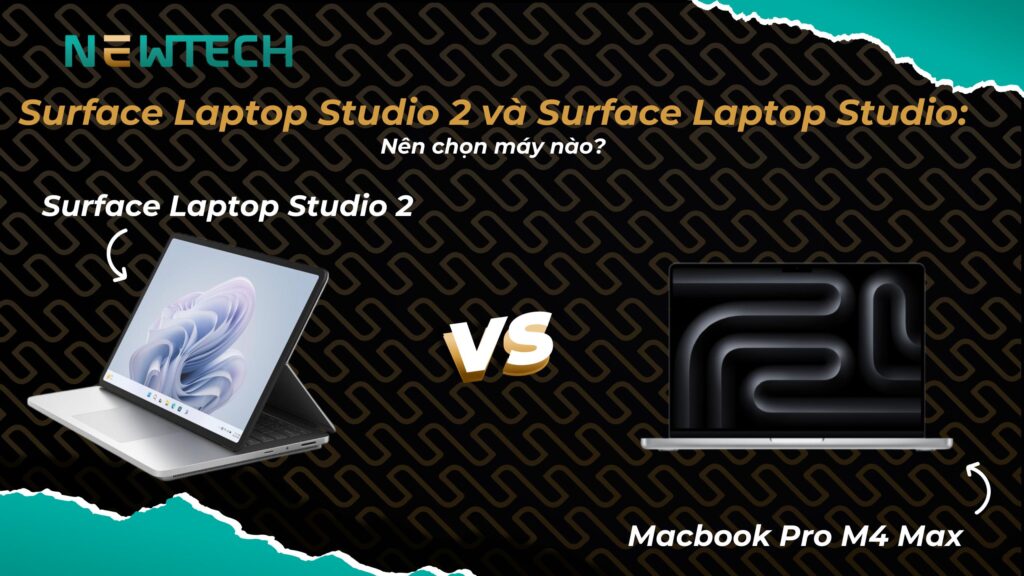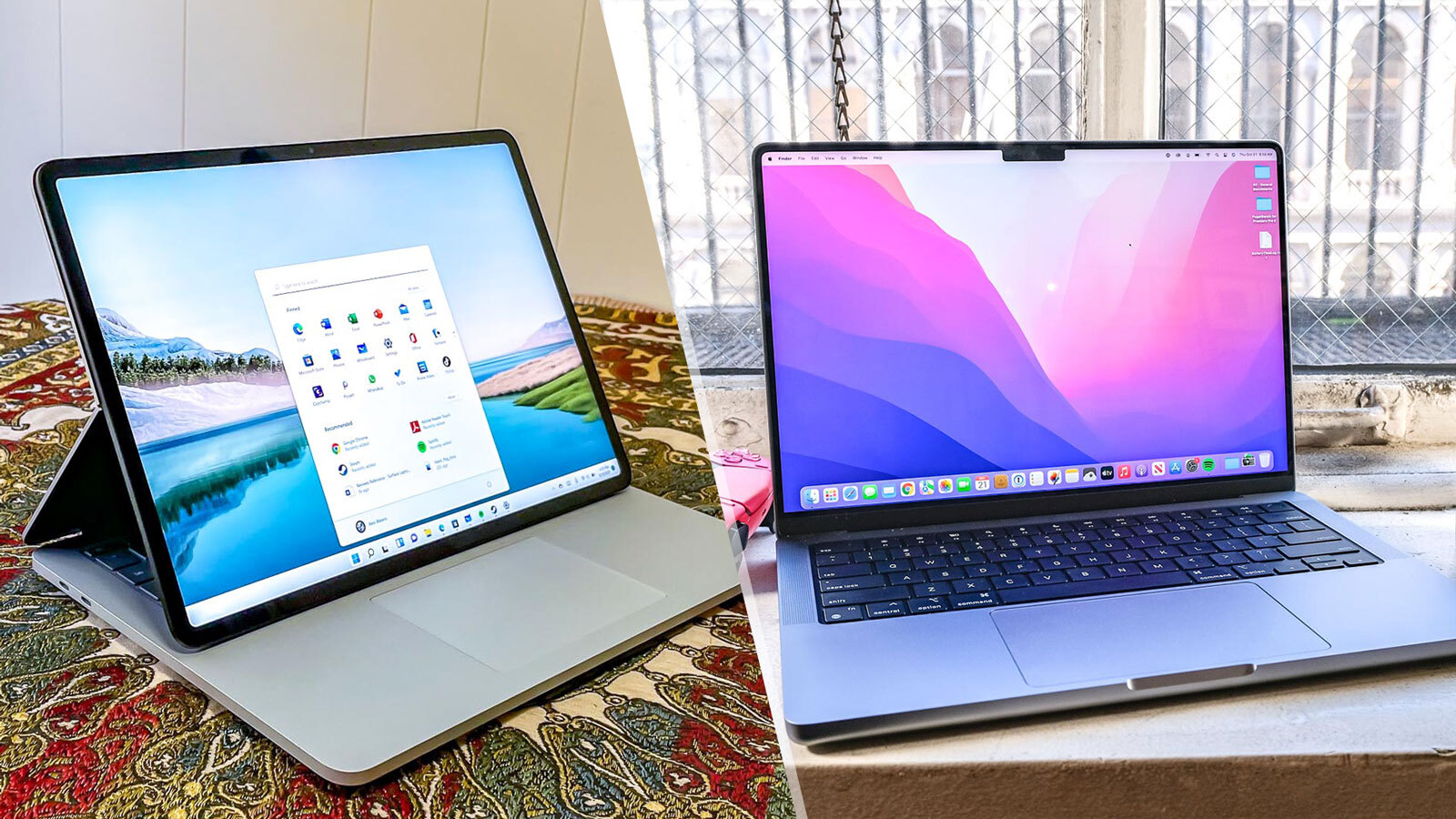

The Titans of Professional Computing: MacBook Pro M4 vs. Surface Laptop Studio 2 – A Deep Dive Comparison
In the fiercely competitive landscape of high-performance laptops, two titans stand out as beacons for creative professionals, engineers, and power users: Apple’s MacBook Pro and Microsoft’s Surface Laptop Studio. With each iteration, both companies push the boundaries of what a portable workstation can achieve, blending raw power with refined design and innovative features. This article delves into an exhaustive comparison between the hypothetical, yet highly anticipated, MacBook Pro with the M4 chip and the currently available Surface Laptop Studio 2, dissecting their philosophies, capabilities, and target audiences.
The MacBook Pro, synonymous with Apple’s macOS ecosystem, has long been the preferred choice for a segment of the professional world, particularly those in creative fields. Its transition to Apple Silicon, starting with the M1 and evolving through M2 and M3, has redefined expectations for performance-per-watt and battery life. The upcoming M4 chip, while not yet officially announced, is expected to build upon this legacy, further enhancing CPU, GPU, and neural engine capabilities, solidifying its position as a powerhouse.
On the other side, Microsoft’s Surface Laptop Studio 2 represents the pinnacle of Windows hardware innovation. It’s a machine designed to be as versatile as its users, boasting a unique adaptable form factor, a powerful combination of Intel’s latest processors and NVIDIA’s discrete graphics, and a deep integration with Windows 11’s touch and pen-centric features. It’s a testament to Microsoft’s vision of a device that seamlessly transitions between traditional laptop, stage, and studio modes.
Choosing between these two premium devices is not merely a matter of specs; it’s a decision that impacts workflow, ecosystem immersion, and fundamental interaction with your computing environment. This comparison will explore every facet, from design and performance to display, input methods, software, and value, helping discerning professionals make an informed choice.
I. Design and Build Quality: Form Meets Function
Both the MacBook Pro M4 and the Surface Laptop Studio 2 exude a premium feel, but they achieve it through distinct design philosophies.
The MacBook Pro M4 (assuming a similar design language to the M3 Pro/Max models) will undoubtedly retain Apple’s iconic unibody aluminum chassis. This design is characterized by its minimalist aesthetic, exceptional rigidity, and a sense of timeless elegance. The precise machining, smooth edges, and balanced weight distribution contribute to a device that feels incredibly solid and reassuringly durable. Its clamshell form factor is conventional but perfected, focusing on a robust hinge mechanism and a slim profile. The attention to detail, from the laser-etched logos to the seamless integration of components, is quintessential Apple. It’s a design that prioritizes a refined, consistent user experience in a traditional laptop orientation.
The Surface Laptop Studio 2, by contrast, is a masterclass in innovative engineering. Crafted from magnesium alloy, it offers a distinct, slightly more industrial aesthetic than the MacBook Pro, but with an equally premium feel. Its most striking feature is its dynamic woven hinge, which allows the display to pull forward into a "stage mode" (ideal for presentations or media consumption) or lay flat over the keyboard in "studio mode" (transforming it into a powerful digital canvas). This versatility is central to its design. While the base is thicker to accommodate the advanced cooling and discrete GPU, the overall footprint remains manageable. The design is less about minimalist purity and more about adaptable utility, catering to professionals who need to switch roles frequently.
Weight and Dimensions: Both machines are portable, but the MacBook Pro generally aims for a slightly thinner and lighter profile for its given screen size, especially in its 14-inch variant. The Surface Laptop Studio 2, due to its discrete GPU and elaborate hinge mechanism, might be marginally heavier and thicker, particularly in the 14.4-inch model, though its weight is still impressive given its capabilities. The choice here comes down to whether you prioritize the ultimate in slimness and traditional laptop elegance or the functional flexibility of a convertible design.
II. The Heart of the Machine: Performance and Raw Power
This is where the philosophical divide between Apple Silicon and the traditional Intel/NVIDIA architecture becomes most apparent.
A. MacBook Pro M4: The Apple Silicon Advantage (Hypothetical)
The MacBook Pro M4 will represent the next evolution of Apple’s custom-designed ARM-based System-on-a-Chip (SoC). Building on the groundbreaking efficiency and performance of the M1, M2, and M3 series, the M4 is expected to deliver:
- CPU: A further refined architecture with an increased core count (performance and efficiency cores), improved IPC (Instructions Per Cycle), and higher clock speeds. This translates to exceptional single-core performance for responsive everyday tasks and robust multi-core performance for demanding professional applications like video editing, 3D rendering, and software compilation.
- GPU: Significant generational leaps in integrated graphics. The M4’s GPU is anticipated to offer more execution units, enhanced ray tracing capabilities, and improved mesh shading. While still an integrated GPU, Apple’s unified memory architecture allows it to access the full pool of high-bandwidth memory, leading to performance that can rival or even surpass entry-level discrete GPUs in many real-world scenarios, especially those optimized for Apple Silicon.
- Neural Engine: A vastly more powerful Neural Engine, crucial for accelerating on-device AI/ML tasks, from photo and video enhancement to advanced voice recognition and intelligent application features.
- Unified Memory: The cornerstone of Apple Silicon. A single, high-bandwidth, low-latency memory pool accessible by the CPU, GPU, and Neural Engine simultaneously, minimizing data transfer bottlenecks and maximizing efficiency. Configurations are expected to range from 16GB up to a staggering 128GB or more in M4 Max variants.
- Efficiency: The hallmark of Apple Silicon. The M4 will likely set new benchmarks for performance-per-watt, delivering incredible power while generating minimal heat, enabling silent or near-silent operation even under heavy loads.
B. Surface Laptop Studio 2: Intel and NVIDIA Unleashed
The Surface Laptop Studio 2 opts for a more traditional, yet incredibly powerful, approach:
- CPU: It features Intel’s 13th Generation (and potentially 14th Gen in future revisions) Core i7 or i9 H-series processors. These are high-performance mobile CPUs with a hybrid architecture combining performance cores (P-cores) and efficient cores (E-cores). They excel in tasks that can fully utilize multiple threads and offer strong raw clock speeds for burst performance.
- Discrete GPU: This is a major differentiator. The SLS2 comes equipped with NVIDIA’s GeForce RTX 4050, RTX 4060, or even the professional-grade RTX 2000 Ada Generation Laptop GPU (for specific SKUs). These discrete GPUs come with their own dedicated VRAM (up to 8GB or more), CUDA cores, and Tensor Cores. They are purpose-built for:
- Gaming: Delivering high frame rates and graphics settings in modern titles.
- 3D Rendering & CAD: Significantly accelerating rendering times in applications like Blender, SolidWorks, AutoCAD, and Unreal Engine.
- AI/ML: Leveraging Tensor Cores for specific AI workloads and frameworks optimized for NVIDIA.
- Video Editing & VFX: Providing hardware acceleration for encoding/decoding, effects, and color grading in Premiere Pro, DaVinci Resolve, and After Effects.
- Traditional RAM: Up to 64GB of DDR5 RAM, which is fast but operates on a different architecture than Apple’s unified memory.
- Thermal Management: To handle the power of an Intel CPU and discrete NVIDIA GPU, the SLS2 employs a robust cooling system, which can result in more fan noise under sustained heavy loads compared to the MacBook Pro.
C. Performance Comparison & Workload Suitability
- Video Editing:
- MacBook Pro M4: Excels in Final Cut Pro X, where its media engines and unified memory provide unparalleled real-time playback and incredibly fast export times. For Adobe Premiere Pro and DaVinci Resolve, the M4 will still offer excellent performance, especially with Apple Silicon optimizations.
- Surface Laptop Studio 2: Shines in Premiere Pro and DaVinci Resolve, particularly for projects utilizing NVIDIA’s CUDA cores for effects, rendering, and specific codecs. The dedicated VRAM can be advantageous for complex timelines and high-resolution footage.
- 3D Rendering & CAD:
- MacBook Pro M4: Impressive for an integrated GPU, especially in Blender’s Cycles X (Metal backend) or other Metal-optimized renderers. Good for moderate 3D work and modeling.
- Surface Laptop Studio 2: Clearly superior for heavy 3D rendering, CAD, and simulation tasks. The dedicated NVIDIA RTX GPU provides significantly faster render times and more robust viewport performance in applications like Blender (CUDA/OptiX), SolidWorks, AutoCAD, and Cinema 4D. This is a critical advantage for engineers and 3D artists.
- Software Development:
- MacBook Pro M4: The undisputed champion for iOS/macOS development (Xcode). Its powerful CPU and memory architecture also make it excellent for general-purpose development, Docker containers, and virtual machines.
- Surface Laptop Studio 2: Excellent for Windows-centric development (Visual Studio, .NET), game development (Unity, Unreal Engine), and cross-platform development. The dGPU can accelerate certain AI/ML development frameworks.
- Graphic Design & Photo Editing (Adobe Suite):
- Both machines handle applications like Photoshop, Illustrator, and Lightroom with ease. The M4’s efficiency and unified memory provide a smooth experience, while the SLS2’s discrete GPU can accelerate certain filters and effects. The touch and pen input of the SLS2 offers a different workflow for digital artists.
- AI/ML Tasks:
- MacBook Pro M4: Its enhanced Neural Engine and unified memory are incredibly efficient for on-device AI model inference and certain training tasks, especially those optimized for Apple’s Core ML framework.
- Surface Laptop Studio 2: NVIDIA’s Tensor Cores and CUDA architecture are highly optimized for a vast array of AI/ML frameworks (TensorFlow, PyTorch), making it a strong contender for specific training and research tasks, particularly where dedicated GPU memory is beneficial.
- Gaming:
- MacBook Pro M4: Apple Silicon is improving rapidly, with more AAA titles arriving on macOS. However, the game library is still limited compared to Windows, and while the M4 GPU will be powerful, it’s not primarily designed for gaming.
- Surface Laptop Studio 2: The clear winner. With an NVIDIA RTX 4050/4060, it can play most modern AAA games at respectable frame rates and resolutions, making it a viable option for professionals who also enjoy gaming.
In summary, the MacBook Pro M4 excels in highly optimized, CPU-intensive, and media-centric workloads, leveraging its incredible efficiency and unified memory. The Surface Laptop Studio 2, with its discrete NVIDIA GPU, is the undeniable powerhouse for tasks requiring dedicated graphical horsepower, such as heavy 3D rendering, advanced CAD, and gaming.
III. Display: A Window to Your Work
The display is the primary interface for creative work, and both laptops offer exceptional visual experiences.
The MacBook Pro M4 will feature Apple’s Liquid Retina XDR display, a mini-LED panel that delivers industry-leading brightness (up to 1600 nits peak for HDR content), an astonishing contrast ratio (1,000,000:1), and incredibly accurate color reproduction (P3 wide color gamut). The ProMotion technology provides adaptive refresh rates up to 120Hz, ensuring buttery-smooth scrolling, responsive content creation, and an immersive viewing experience. Mini-LED technology allows for precise local dimming, resulting in true blacks and vibrant HDR content, making it ideal for video editors, photographers, and graphic designers.
The Surface Laptop Studio 2 boasts a 14.4-inch PixelSense Flow display. It’s a high-resolution (2400 x 1600 pixels, 201 PPI) IPS LCD panel with a 120Hz refresh rate and support for Dolby Vision IQ. While not mini-LED, it offers excellent color accuracy, good brightness (around 500 nits typical), and a high contrast ratio. Crucially, it is a multi-touch display with support for Microsoft’s Slim Pen 2, which offers haptic feedback for a more natural inking experience. The aspect ratio (3:2) provides more vertical screen real estate, which is beneficial for productivity and digital art.
Key Differences:
- Backlighting: MacBook Pro’s mini-LED offers superior contrast and HDR performance with true blacks. SLS2 uses a traditional IPS LCD, albeit a very high-quality one.
- Brightness: MacBook Pro is significantly brighter for HDR content.
- Touch/Pen: Surface Laptop Studio 2 offers a full touch screen and exceptional pen support, a feature absent from the MacBook Pro.
- Aspect Ratio: SLS2’s 3:2 aspect ratio is slightly taller, offering more vertical workspace compared to the MacBook Pro’s 16:10.
For pure visual fidelity and HDR work, the MacBook Pro’s Liquid Retina XDR is arguably superior. However, the Surface Laptop Studio 2’s display is excellent in its own right and adds the invaluable dimension of touch and pen input, transforming it into a versatile digital canvas.
IV. Form Factor and Input Methods: Interaction and Versatility
This category highlights the most fundamental difference in how users interact with these machines.
A. Form Factor
- MacBook Pro M4: Adheres to the classic clamshell laptop design. It opens and closes, and that’s its primary mode. This simplicity is its strength, providing a stable, unwavering platform for keyboard and trackpad interaction.
- Surface Laptop Studio 2: Its defining characteristic is its adaptable form factor:
- Laptop Mode: A traditional laptop experience.
- Stage Mode: The display pulls forward, detaching from the base of the keyboard but remaining connected at the hinge, tilting forward to obscure the keyboard. Ideal for media consumption, presentations, or showcasing content.
- Studio Mode: The display folds completely flat over the keyboard, transforming the device into a powerful digital drawing board or tablet. This mode, combined with the Slim Pen 2, is a game-changer for artists, designers, and note-takers.
B. Keyboard and Trackpad
- MacBook Pro M4: Features the Magic Keyboard, known for its comfortable key travel, stable keys, and consistent tactile feedback. It’s widely regarded as one of the best laptop keyboards available. The Force Touch trackpad is an industry benchmark – large, precise, and offering haptic feedback that simulates clicks anywhere on its surface, along with multi-touch gestures.
- Surface Laptop Studio 2: Offers an excellent keyboard with satisfying key travel and a good tactile response. It’s a comfortable typing experience, though some might argue it doesn’t quite match the MacBook Pro’s in terms of sheer refinement. The haptic trackpad is also large and precise, offering a premium feel and supporting Windows Precision gestures. While very good, it generally ranks just behind Apple’s Force Touch trackpad in expert reviews.
C. Touch and Pen Input
- MacBook Pro M4: Does not offer a touch screen or native pen input. Apple’s philosophy has traditionally kept macOS a mouse/trackpad-centric experience.
- Surface Laptop Studio 2: This is its strongest differentiator. The multi-touch display is responsive and accurate, and the integration of the Slim Pen 2 is seamless. The Slim Pen 2 charges magnetically under the display’s lip, offers excellent pressure sensitivity, tilt support, and unique haptic feedback that mimics the feel of pen on paper. This makes the SLS2 an unparalleled tool for digital art, design sketching, detailed annotation, and natural note-taking within the Windows ecosystem.
D. Biometric Security
- MacBook Pro M4: Features Touch ID integrated into the power button, providing fast and secure fingerprint authentication.
- Surface Laptop Studio 2: Uses Windows Hello facial recognition via its IR camera for quick and secure login, often preferred for its hands-free convenience. It also includes a fingerprint reader.
For users who primarily type and use a trackpad, both offer top-tier experiences. However, for anyone requiring a touch interface or precise pen input, the Surface Laptop Studio 2 is the unequivocal choice.
V. Ports and Connectivity: Expanding Your Horizon
Connectivity is crucial for professionals who often interface with external displays, storage, and peripherals.
The MacBook Pro M4 (depending on the specific M4 variant – Pro or Max) typically offers a streamlined set of ports:
- Thunderbolt 4 (USB4) ports: Usually 2 or 3, depending on the model. These are incredibly versatile, supporting power delivery, external displays (up to 8K), and high-speed data transfer (up to 40Gbps).
- HDMI port: For direct connection to external monitors and TVs.
- SDXC card slot: A welcome return for photographers and videographers.
- MagSafe 3: Apple’s magnetic charging port, offering convenience and safety.
- 3.5mm headphone jack: With high-impedance headphone support.
The Surface Laptop Studio 2 offers a more traditional, yet comprehensive, selection:
- Thunderbolt 4 ports: Two ports, offering similar versatility for power, displays, and data as the MacBook Pro.
- USB-A 3.1 port: Crucial for legacy peripherals without needing a dongle.
- microSDXC card reader: For quick photo/video transfer.
- 3.5mm headphone jack: Standard audio output.
Connectivity Comparison:
- The MacBook Pro’s strength lies in its multiple high-bandwidth Thunderbolt ports and the full-size SDXC slot.
- The Surface Laptop Studio 2’s inclusion of a USB-A port means fewer dongles for many users, and while it has a microSDXC slot, some professionals might prefer a full-size SD.
- Both offer modern wireless connectivity with Wi-Fi 6E and Bluetooth 5.3/5.4, ensuring fast and reliable wireless networking and peripheral connections.
Ultimately, the MacBook Pro’s port selection is excellent for a modern, Thunderbolt-centric workflow, while the Surface Laptop Studio 2 offers a bit more out-of-the-box versatility for those still relying on USB-A.
VI. Battery Life: Power Through Your Day
Battery life is a critical factor for professionals on the go, and this is an area where Apple Silicon has consistently set industry benchmarks.
The MacBook Pro M4, leveraging the exceptional power efficiency of Apple Silicon, is expected to deliver truly outstanding battery life. With the M3 generation already pushing 18-22 hours of video playback or web browsing, the M4 is likely to maintain or even extend this lead. For typical professional workloads like coding, document editing, and light creative tasks, users can expect to comfortably get through a full workday, and often more, without needing to reach for a charger. This is a significant advantage for mobile professionals.
The Surface Laptop Studio 2, while offering commendable battery life for a Windows laptop with a discrete GPU, generally cannot match the endurance of the MacBook Pro. With its powerful Intel CPU and NVIDIA GPU, battery life will vary significantly depending on the workload. For light tasks, it might offer 10-14 hours, but engaging the discrete GPU for gaming, 3D rendering, or heavy video editing will significantly reduce this, potentially to just a few hours. Microsoft has made strides in efficiency, but the fundamental architecture of an x86 CPU combined with a dedicated GPU inherently consumes more power than Apple Silicon for similar performance.
For users prioritizing maximum unplugged time, the MacBook Pro M4 will undoubtedly be the superior choice.
VII. Software and Ecosystem: The Operating System Divide
The choice between these laptops often boils down to a fundamental preference for either macOS or Windows, and the ecosystems they support.
A. macOS Sonoma (and future versions) on MacBook Pro M4
- User Experience: Renowned for its elegant, intuitive, and consistent user interface. It offers a refined desktop experience with excellent multitasking features (Stage Manager, Mission Control).
- Ecosystem Integration: Seamless integration with Apple’s vast ecosystem (iPhone, iPad, Apple Watch, AirPods, iCloud). Features like Universal Clipboard, Handoff, AirDrop, and Sidecar (using an iPad as a second display) create a cohesive and productive environment.
- Pro Applications: Exclusive access to Apple’s professional software suite, including Final Cut Pro (video editing), Logic Pro (music production), and Xcode (iOS/macOS development). Adobe Creative Cloud suite and other major pro apps are highly optimized for Apple Silicon.
- Security & Stability: macOS is generally considered very stable and secure, with robust privacy features.
- Unix Underpinnings: Appeals to developers and power users who appreciate its Unix-based foundation.
B. Windows 11 on Surface Laptop Studio 2
- Software Compatibility: Unparalleled software compatibility. If a professional application exists, it almost certainly runs on Windows. This includes niche engineering software, specific CAD programs, and the vast library of PC games.
- Versatility: Windows 11 is optimized for touch and pen input, making the Surface Laptop Studio 2’s adaptable form factor shine. Features like snap layouts, virtual desktops, and the new Copilot AI assistant enhance productivity.
- Open Ecosystem: Offers greater flexibility in hardware choices and customization.
- Gaming: The undisputed platform for PC gaming, with a massive library of titles.
- Microsoft 365 Integration: Deep integration with Microsoft’s suite of productivity applications (Word, Excel, PowerPoint, Outlook, Teams).
- AI Integration: With Copilot, Windows 11 is increasingly integrating AI directly into the operating system, offering intelligent assistance across various tasks.
The decision here is deeply personal. If you are deeply embedded in the Apple ecosystem or rely on Apple-exclusive software, macOS is the natural choice. If you require broad software compatibility, especially for specialized engineering or design applications, need discrete GPU power for specific tasks, enjoy PC gaming, or leverage touch and pen input, Windows 11 on the Surface Laptop Studio 2 offers unmatched versatility.
VIII. Price and Value Proposition: Investment in Your Workflow
Both the MacBook Pro M4 and the Surface Laptop Studio 2 are premium devices, representing significant investments.
The MacBook Pro M4 will likely start at a high entry price, with configurations quickly escalating, especially for M4 Pro or M4 Max chips with increased unified memory and storage. While the initial outlay can be substantial, Apple products traditionally hold their resale value exceptionally well, making the total cost of ownership potentially lower over time. The value proposition lies in its long-term performance, efficiency, software optimization, and ecosystem.
The Surface Laptop Studio 2 also comes with a premium price tag, which scales up significantly with higher-end Intel CPUs, more RAM, larger storage, and particularly the more powerful NVIDIA RTX GPUs. Its value proposition is tied to its unique versatility (three-in-one form factor), the inclusion of a powerful discrete GPU, and the seamless integration of touch and pen input within the Windows ecosystem. For users who can fully leverage these features, the price is justified.
When comparing prices, it’s crucial to configure both machines with comparable levels of CPU/GPU power, RAM, and storage, while also factoring in necessary accessories (e.g., the Slim Pen 2 for the SLS2, if not included).
IX. Who Are These Laptops For? Defining the Target Audience
The distinct strengths of each device carve out clear target audiences.
The MacBook Pro M4 is ideal for:
- Video Editors and Filmmakers: Especially those using Final Cut Pro, but also excellent for Premiere Pro and DaVinci Resolve users seeking efficiency and raw processing power for media.
- Music Producers and Audio Engineers: Logic Pro users will find unparalleled integration, and the powerful CPU is perfect for complex projects with numerous tracks and plugins.
- Software Developers: Particularly those developing for iOS, macOS, or general-purpose coding where a Unix-based environment and powerful CPU are paramount.
- Graphic Designers and Photographers: Leveraging the stunning Liquid Retina XDR display and powerful CPU for Adobe Creative Suite applications.
- Academics and Researchers: Who value long battery life, reliability, and powerful processing for data analysis and computation.
- Professionals prioritizing: Unmatched battery life, silent operation, a streamlined macOS workflow, and deep integration with the Apple ecosystem.
The Surface Laptop Studio 2 is the perfect fit for:
- Digital Artists and Illustrators: The Studio mode and Slim Pen 2 offer an unparalleled digital canvas experience.
- 3D Modelers, Animators, and Architects: The discrete NVIDIA RTX GPU provides significant acceleration for rendering, CAD software, and 3D design tools.
- Engineers and Scientists: Who rely on Windows-exclusive or GPU-accelerated software for simulations, data processing, and analysis.
- Game Developers: Benefiting from the powerful GPU and Windows’s native game development environment.
- Gamers: Who want a powerful, portable machine that can handle modern AAA titles.
- Professionals needing: A versatile device that transitions between laptop, tablet, and presentation modes, robust discrete graphics, touch and pen input, and broad Windows software compatibility.
X. Conclusion: The Right Tool for Your Trade
The comparison between the MacBook Pro M4 and the Surface Laptop Studio 2 isn’t about declaring an absolute winner; it’s about identifying the best tool for specific professional needs. Both are exemplars of high-end portable computing, but they cater to different priorities and workflows.
The MacBook Pro M4 stands as a testament to raw, efficient power and a meticulously refined user experience within the macOS ecosystem. Its expected M4 chip will offer unparalleled CPU performance, formidable integrated graphics, and legendary battery life, all encased in an elegant, robust aluminum chassis with a world-class display. It is the go-to choice for those deeply embedded in the Apple ecosystem, demanding top-tier CPU and media performance, and prioritizing efficiency, battery longevity,